The Honda City is now in its third generation, and has been launched in countries such as Singapore, Thailand and India. In line with the global economic outlook as well as global fuel prices, manufacturers have been downsizing their cars and the new City makes a perfect compact sedan in the Honda line-up slotted in under the Civic for world markets. It is considered to be a world car now, as it has also been recently revealed that the City will also be sold in Europe. Look after the jump for an in-depth look at the new City.
Design

The first generation Honda City (not including the old little car that also came with a turbocharged engine) was designed as an ASEAN car that came with engines such as the 1.5 liter SOHC VTEC engine. It was quite a popular choice as a budget and “boxier” version of the Civic.
The second generation is the City that is currently sold in Malaysia, and while it was a solid offering in terms of drivability, fuel economy and performance, it had one major problem - its looks. Being a sedan version of the Honda Jazz subcompact, the Honda City ended up looking like a steam iron. Some even called it a flowerhorn.
Many customers could not get over its looks and opted for the Toyota Vios instead, but most of those who put their money on the City were quite happy with it, especially the buyers of the i-DSI version which offered superior fuel economy. It also allowed customers to enjoy a smooth CVT that always keeps the engine in its peak powerband.
Now for the 2009 model year, while the City is still somewhat based on the Jazz especially with its underpinings, there is no resemblance on the outside at all. Instead, the City now looks like a sedan version of the European Honda Civic hatch with a nice roofline instead of the previous City’s steam iron roofline. In fact, since the European City is based on a platform with a rear torsion bar, the Euro Civic may have more in common with this new City than we think!

Honda calls the design concept of the new Honda City the “arrowshot”, as you can see from the sketch above. The car seems to concentrate all its forces on a point at a front, while the rear has a raised deck lid for a more upright stance. This makes the City look like its ready to release energy even when it is static. As with the Honda Accord, there are some hints of BMW-like design with the new City, especially with the rear end and that Hoffmeister kink at the C-pillar.
The front end of the car looks like it was lifted off the European Civic hatchback, with the grille from the Honda FCX Clarity. It looks quite concept-car-like, and I would say Honda was quite brave to have pulled this one off. I think there will be quite a few people who will be turned off by the Optimus Prime futuristic look on the front end - but they can look at the aftermarket “solution providers” if they dislike it. I think the rest of the car looks good - the rooflline does not flow as sleekly as the Civic, but its a huge improvement over the previous City.
As for the wheels, you get either a 5-spoke wheel for the 15 inch size, or those funky Y-shaped 5-spokers for the 16 inch size. For markets that call for a low-cost City (maybe we will get one to compete with the Vios J?), there is a 3-piece 5-poke design wheel cover on steel wheels in 15 inch size. The tyre sizes are 175/65R15 and 185/55R16.
Interior

Firstly, the doors open 80 degrees for easy access to the interior. In the interior, you get an instrument panel that is traditionally positioned behind the steering wheel. Good for those who dislike centrally-mounted instrument panels. There are two colour schemes - one beige and one black. Both will likely be used by Honda Malaysia, with the black for a high-spec or sports-specced version of the car and a beige one for the other. The black interior uses black for all the plastic parts while the fabric is in a purplish-black colour. The beige interior uses a grayish-beige tone for the plastic parts while the fabrics are done in beige with yellow overtones.
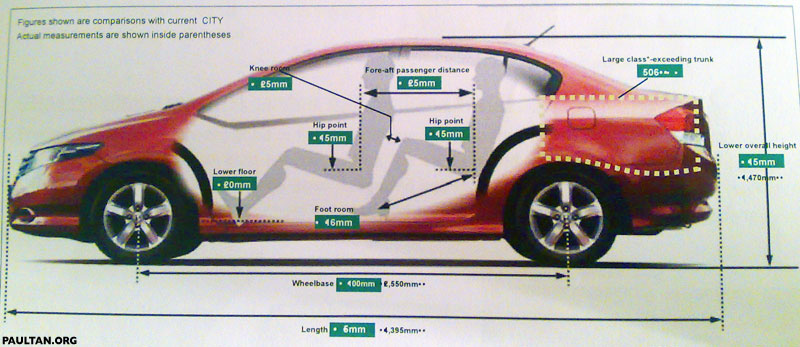
To reduce the previous City’s odd looks, Honda has made the car 45mm lower, but to maintain a good amount amount of headroom, they’ve changed the seat rail design and reduced cushion thickness (though they claim comfort is maintained) to reduce the driving position by 15mm. This allows a lower roofline for a sleeker shape while keeping a decent amount of headroom.

The front quarter window has been removed and the A-pillars have been made thinner by 14mm for better visibility. In addition, the mirror area for the wing mirrors have been made taller but slightly slimmer for a more square shape, compared to the previous generation’s more rectangular side mirrors. This results in an increased mirror size by about 15 percent for better rear visibility. The front wipers have also been repositioned to have reduced front windscreen protrusion by 20mm.
The air-conditioning system is available with both manual and automatic controls, and the center dash area looks significantly better with the automatic controls are the design of the manual controls end up making the dash look cheap. The air conditioning blowers have their noise reduced by 4dB while increasing airflow capacity by 10%. Honda has added better filter to reduce outside odors from entering the cabin. In addition to the front air outlets, Honda has attempted to design the airflow to hit the rear bench via the bottom blowers which travel under the front seat to cool the rear passenger area.

There are a few storage areas around the interior - a glovebox in the dashboard, a storage tray for small items underneath the handbrake, a storage area in the center armrest with a cardholder, a pocket for small items under the air conditioning vent on the driver’s side, a coin pocket below that, a cup/bottleholder and a storage area in the front door pockets, a cupholder between the two front seats, a cupholder in front of the shift lever, and cupholders in the rear armrest.
The instrumentation panel features a trip computer that can display fuel consumption in kms per liter in real time, as well as average fuel consumption and distance in km remaining until the fuel tank is empty. With an instant fuel consumption meter, the driver can teach himself how to drive fuel efficiently by monitoring how much fuel he is using in various driving scenarios.

The rear seats have a little storage space underneath it and Honda has suggested you store your umbrella there in the product photos they have shot. The rear bench splits and folds 60:40 and has an armrest integrated into the center with two cupholders in it. The Ultraseats feature seems to be gone now - these are probably just regular split-fold rear seats, though there is an option for a version with a 2-position recline system.
The driver’s seat features a ratchet-operated seat height adjuster to adjust seat height by up to 50mm. Something that is quite rare for a B-segment sedan is the ability to adjust the reach of a steering wheel in addition to the usual tilt. This means the steering wheel can move towards and away from you as well as having its tilt adjusted up or down. However, there is also a tilt-only steering wheel option for the City, which means each country’s product planners will have to decide which spec level gets the tilt-and-telescope (rake-and-reach) and which one gets the tilt-only.
Dimensions

The extended wheelbase (100mm longer from 2450mm to 2550mm) allows for a larger interior space. This increases legroom by 25mm. Other changes to the interior include a floor that is lower by 20mm, and 15mm more footroom for the rear passenger. A more comfortable footrest has been installed thanks to the space made available by moving the accelerator and brake pedals 15mm to the right.
While the wheelbase is longer, the wheels are nearer to the edges of the vehicle, resulting in an increase of length of only 5mm, which means its not much harder to fit into side parking spaces compared to the previous City. The trunk exceeds the 500 liter mark slightly at 506 liters, however it seems that the width of the entry into the boot space would be better if it was wider.
| Old City | New City | Vios |
| Length | 4390 | 4395 | 4300 |
| Width | 1690 | 1715 | 1700 |
| Height | 1485 | 1470 | 1460 |
| Wheelbase | 2450 | 2550 | 2550 |
| Weight | 1090kg | 1155kg | 1045kg |
| Power | 110 PS@5,800 | 120 PS@6,600 | 109PS@6,000 |
| Torque | 143Nm@4,800 | 145Nm@4,800 | 141Nm@4,200 |
New 1.5L i-VTEC Engine

The new L-Series SOHC i-VTEC engine in the 2009 Honda City is the same unit as found in the 2nd generation Honda Jazz. It produces 120 PS at 6,600rpm and 145Nm of torque at 4,800rpm, making it one of the most powerful 1.5 liter units today.
Unlike the SOHC VTEC unit in the previous Honda City VTEC which only switched between opening and closing 1 of 2 intake valves per cylinder, the new i-VTEC engine actually varies the valve timing and valve lift, though this is not a continuously variable system like in the K-Series i-VTEC, but instead switches over at pre-set RPM points.
 Interestingly you can see a small dip in the torque curve at around 3,300 to 3,500rpm before it picks up again immediately, which is probably just about before the i-VTEC engine switches to a more aggressive cam profile.
Honda actually acknowledges this and claims the torque dip provides a smoother drive, whatever that means! The good news is this engine is compatible with RON92 fuel which should allow you to save on your fuel bills a little.
There are quite a few other improvements in this new engine. The new engine now features 4 valves per cylinder, with larger 28mm diameter intake valves.
Valve area is increased by 4%, and this reduces pumping losses and improves maximum output. The throttle is controlled via Drive-By-Wire which transmits accelerator pedal position via an electric signal.
The engine switches from the use of two oxygen sensors in the previous City VTEC engine to a new air-fuel ratio control system that uses one oxygen sensor and one Linear Air-Fuel Ratio sensor (LAF sensor). This allows a higher level of precision.
The conrod is made of hot-forged, high-tension steel which has an improved fatigue strength of approximately 50%. This allows a 17% reduction in the conrod cross-section area to reduce weight by about 1kg. This also allows the engine to rev higher because of reduced inertial force.
A combustion chamber shape that would suppress engine knock was also developed, which features a more compact piston head thanks to thicker piston edges to prevent residual gas accumulation. The coolant flow in the water jacket has been redesigned from a dual-flow structure to a single-flow structure which flows into the block ahead of the cylinder head. This allows a concentrated coolant flow that improves cooling efficiency, further improving knock resistance.
As a result, engine knock is reduced, which means more aggressive ignition timings can automatically be used, which can be felt with an increase in low-end torque. Torque is further enhanced with the adoption of a resonator chamber in the intake manifold.
In addition, the rocket arm is stronger by 20% thanks to stronger aluminium. Another 1kg is shaved off via the use of a lightweight plastic head cover. The cylinder head has an integrated exhaust manifold which helps bring the high thermal resistance catalytic converter closer to the engine. This allows the catalyst to warm up faster and also reduces cost because there is less precious metal needed in the catalyst.
NVH is improved with the use of an auto-tensioner for the auxiliary belt drive system so that belt tension is stabilized, with the variations in tension automatically regulated in accordance with load. The engine also has a new patterned piston coating is claimed to be the first in the world and a proprietary Honda technology. The shape around the piston skirt is modified to reduce both piston slap noise and friction. The pattern also improves oil retention which reduces friction even more.
Transmissions

Both the manual and automatic transmissions available for the new Honda City in our region are 5-speed units. Other markets such as Japan will likely get the CVT transmission while Europe gets a 6-speed i-SHIFT automated manual transmission.
Honda says the ASEAN market prefers the feel that a 5-speed automatic transmission gives, hence the switch from the CVT gearbox in the previous generation City. The CVT also had alot of bad talk going around about being expensive to maintain/replace, which has put off some people I know from considering used Citys.
As shown from the graph above, the 5-speed auto is less rubber-band-like when you hit the throttle from a standstill. It kicks in faster and harder, but soon after the CVT takes over while the 5-speed auto slowly catches up… and you can see towards the right of the graph that performance is similiar after the initial take-off.
There is the option for paddle shifters on the steering wheel - left to downshift and right to upshift. In D mode selected on the gear lever, you can use the paddles to quickly downshift or upshift whenever you need it to, but the transmission returns to fully automatic mode after awhile with no shift activity.
There is another mode - S mode, which at first puts you into a sporty automatic mode that keeps the revs up higher than usual, but if you start using the paddle shifters it goes into a manual mode that stays in the gear you have selected even after the absence of shift activity after awhile. Who knows, you may want to use your 2nd gear for your entire journey for some particular reason - the transmission will let you.
The 5-speed manual has a new carbon synchromesh for smoother shifts and an optimised clutch pedal stroke. The following are the ratios for both transmissions:
| 1st | 2nd | 3rd | 4th | 5th |
| Manual | 3.461 | 1.869 | 1.235 | 0.948 | 0.809 |
| Auto | 2.995 | 1.678 | 1.066 | 0.760 | 0.551 |
Ride and Handling

The 2009 Honda City features a MacPherson strut setup at the front and a torsion beam at the rear. There are a few enhancements over the design used in the previous generation City. For the front suspension, the kingpin axis has been rotated rearward for an enlarged caster angle and increased caster offset. This improves straight-line stability. The ride is also made more supple via larger capacity compliance bushes.
The torsion beam has a reduced spring lever ratio (reduced from 1.54 to 1.11) and an increased trailing arm bush capacity for a more supple ride comfort. Roll steer and roll camber has also been improved for better handling. The rear suspension attachment points have been reinforced as with the rear damper attachment point structure. The rear bulkhead also has increased rigidity.
The car’s Electric Power Steering now has an increased motor capacity (from 40A to 60A) and a modified gearbox mount for a more steady and direct feel, leading to a more enjoyable and confident driving experience.
In-Car Entertainment

Now this is quite interesting, by default the Honda City does not come with a CD player. It does support WMA and MP3, but these have to be loaded from USB instead of being loaded from a CD. There is also aux support for analog sound input. Honda probably thinks all the young urban buyers of this new City will have forgotten the CD already, instead preferring to use their portable media player (such as the iPod) or MP3 or WMA files whenever possible, whether burned on CD or stored on a USB drive.
You can either connect your iPod or a USB drive to the USB input. If you connect an iPod, the center rotary selector on the head-unit performs the same functions as the iPod’s clickwheel.
For those who absolutely need CD support, the little storage area accessible when you flip up one panel of the head unit that is meant for you to store your MP3 player is also a 1-DIN slot for you to install your own CD player. Honda’s product planners for each country may also choose to equip their offering with a head unit that has a CD player already built-in.
The 2009 Honda City now also has an option for a premium sound system, though I am not sure whether Honda Malaysia will put this in one of the trim levels of their local offering. The premium audio uses a 45W x 4 channel amplifier sending sound to four PP cone speakers with neodymium magnets and two hard-dome tweeters. The head-unit’s DSP equalizer is tuned to match the interior sound characteristics.
Safety
Thanks to the European homologation processes, the new Honda City has increased safety, especially for pedestrians. The engine hood, hood hinges, front fenders, front bumper, front windshield support structure and even the wipers are designed to absorb energy easily and bend out of the way whenever possible for better pedestrian crash safety. All of this also helps the passengers in the cabin as all the energy is absorbed instead of being channeled into the cabin into the legs of the front passengers.
The brake discs at the front are of a larger diameter compared to the outgoing model and the brake master cylinder has been made longer but with a smaller diameter. Honda says this allows a more powerful brake booster performance while offering a lower pedal ratio for a more linear brake pedal feel.
Other safety features include SRS airbags, active headrests to prevent whiplash injuries for the front passenger and driver, and the usual combination of ABS and EBD. There is still no traction control offered though, not even on the European model as far as I can tell.
So there you have it, the new 2009 Honda City explained to you in-depth together with comparisons with its rival the Toyota Vios and the previous generation Honda City. Next up: a test drive review of the new Honda City!
But for now, enjoy more photos of the new City including live photos from the 2008 Singapore Motor Show.
PHOTO GALLERY: 2009 Honda City Click thumbnails to view high resolution photo


PHOTO GALLERY: 2009 Honda City - European Spec
Click thumbnails to view high resolution photo


PHOTO GALLERY: 2009 Honda City - LIVE Photos
Click thumbnails to view high resolution photo


From : paultan.org